


Trump Accounts Explained: What Florida Families Need to Know
Published 2026 by McDonough Capital Management, Orlando, Florida. Informational only, not tax or investment advice.
A new federal savings account gives most American children a tax-deferred head start on building wealth. Here is how a Trump Account works, who qualifies, and how it fits alongside the accounts families already use.
What Is a Trump Account?
A Trump Account is a new type of tax-deferred individual retirement account (IRA) for children under age 18, created by the One Big Beautiful Bill Act, which was signed into law on July 4, 2025. Any child with a valid Social Security number can have one. Children who are U.S. citizens and born between January 1, 2025 and December 31, 2028 also qualify for a one-time $1,000 seed contribution from the federal government. Contributions to these accounts became allowed starting July 4, 2026.
In plain terms, a Trump Account is a way to start investing for a child from birth. The money grows tax-deferred inside the account, and for a large group of newborns, the government funds the first $1,000. It is the first federal child savings program of its kind, and because the rules are new, many Florida families are still sorting out how it works and whether it belongs in their plan.
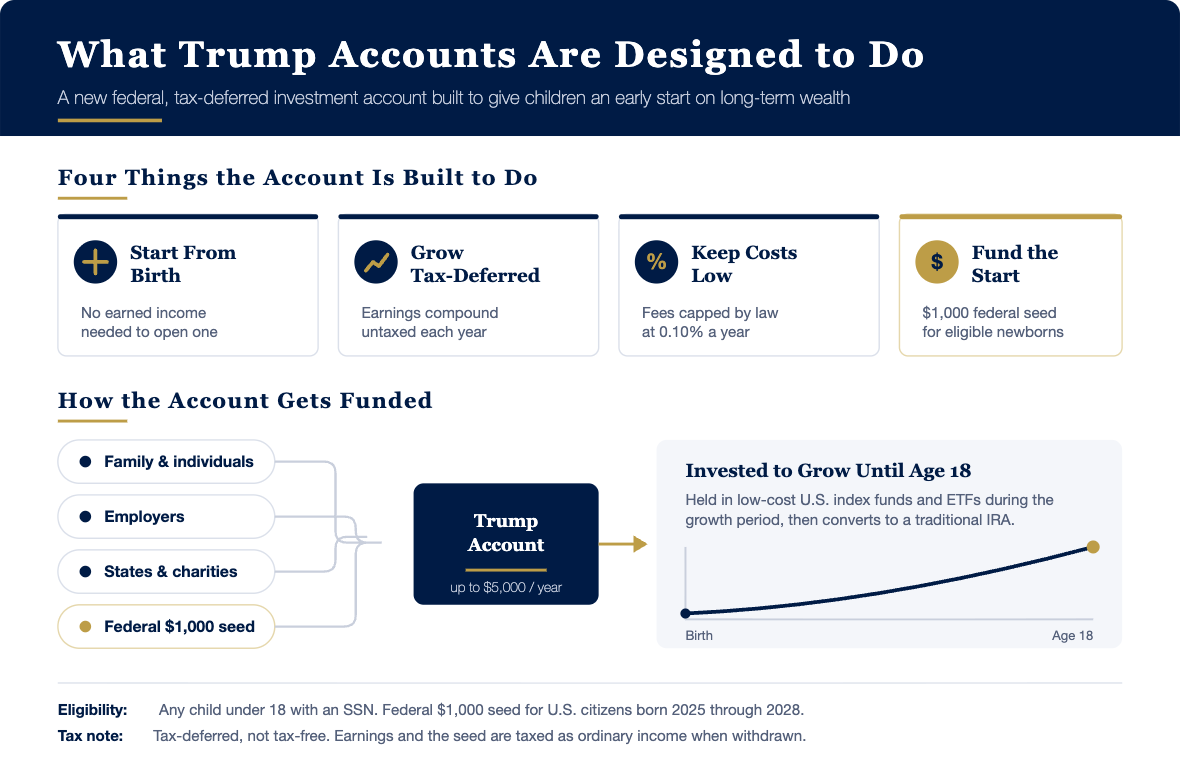
Trump Account: the facts at a glance
| Feature | Detail |
|---|---|
| Account type | A traditional IRA for a minor, with special rules until the year the child turns 18 |
| Who is eligible | Any child under 18 with a Social Security number |
| $1,000 federal seed | U.S. citizen children born January 1, 2025 through December 31, 2028, if a parent or guardian files the election |
| Annual contribution limit | Up to $5,000 per year from family and other individuals; employers may add up to $2,500 within that limit |
| Contributions begin | July 4, 2026 |
| Investments allowed | Low-cost U.S. equity index funds and ETFs, with a 0.10% expense-ratio cap |
| Access to funds | Generally, none until the year the child turns 18 |
Who Qualifies, and How Does the $1,000 Seed Work?
Two questions get mixed up often, so it helps to separate them. Any child under 18 with a Social Security number can have a Trump Account opened for them. The one-time $1,000 government contribution is narrower: it goes only to children who are U.S. citizens and born between January 1, 2025 and December 31, 2028.
The seed money is not automatic. A parent or legal guardian must make an election on the child's behalf, typically by filing IRS Form 4547, before the account can receive the $1,000. Children born before 2025 can still have a Trump Account opened for them. However, they do not receive the federal seed contribution.
Beyond the seed, several sources can fund the account during the growth period:
- Family members and other individuals can contribute up to $5,000 combined per year.
- Employers can contribute up to $2,500 per year, counted within that $5,000 limit.
- States, tribal governments, and qualifying charitable organizations can make separate contributions that do not count against the $5,000 cap.
Contributions during childhood are made with after-tax dollars and are not tax-deductible. That is an important distinction from a workplace retirement plan, and it shapes how the money is taxed later.
How Is a Trump Account Taxed?
A Trump Account is tax-deferred, not tax-free. Investments grow without being taxed each year, which lets earnings compound over a long horizon. The tax comes due at withdrawal. Because the account is structured as a traditional IRA, the money the child eventually takes out is treated in two parts: the after-tax contributions come back out tax-free, while the earnings, the $1,000 federal seed, and any employer contributions are taxed as ordinary income when withdrawn.
This is the single most common point of confusion, so it is worth stating plainly: a Trump Account does not work like a Roth IRA or a 529 plan, where qualified withdrawals can be entirely tax-free. An earlier draft of the law would have allowed capital-gains treatment on the growth, but the final version dropped it, so standard traditional-IRA rules apply.
On January 1 of the year the child turns 18, the account generally converts to a standard traditional IRA. From that point, normal IRA rules govern it: withdrawals are taxed as ordinary income, and a 10% penalty can apply to withdrawals taken before age 59 and a half, with the usual exceptions such as up to $10,000 toward a first home or amounts used for qualified higher-education expenses. Florida has no state income tax, so a Florida resident who keeps the account here would owe no state tax on a withdrawal, though state tax rules can change and vary by residence.
How Does a Trump Account Compare to a 529 Plan or a Custodial Roth IRA?
A Trump Account is one tool among several for building wealth on behalf of a child, and it is rarely an either-or decision. Each account is built for a different purpose. The table below sets the three side by side on the points that families ask about most.
| Feature | Trump Account | 529 Plan | Custodial Roth IRA |
|---|---|---|---|
| Primary purpose | Long-term, retirement-style savings | Education expenses | Retirement savings for a child with earned income |
| Earned income required | No | No | Yes |
| Growth | Tax-deferred | Tax-deferred | Tax-free |
| Qualified withdrawals | Earnings taxed as ordinary income | Tax-free for education | Tax-free in retirement |
| Government seed | $1,000 for eligible newborns | None (some state incentives) | None |
| Annual limit | $5,000 | High, set by each state plan | Up to the child's earned income, capped at the IRA limit |
The practical takeaway: a 529 plan remains the stronger vehicle for college costs, and a custodial Roth IRA is hard to beat for a teenager with a summer job. A Trump Account fills a different slot, an early, no-earned-income-required start on long-term savings, seeded for many families with $1,000 they would not otherwise have. Used together, these accounts can cover education, early retirement savings, and general long-term growth without overlap.
The question that matters: For most families, the useful question is not whether a Trump Account is good or bad in the abstract. It is how the account fits within an existing plan already built around goals, cash flow, and the other accounts a household is funding. That is a planning question, not a product question.
What Should Families Weigh Before Opening One?
The strengths of a Trump Account are real: a long runway for compounding, a legally capped 0.10% expense ratio that protects small balances, and for eligible newborns, $1,000 in funding at no cost. A few tradeoffs deserve equal attention.
- The money is locked up until 18. Withdrawals are generally not permitted during the growth period, so these dollars are not an emergency fund or a near-term college account.
- Earnings are taxed on the way out. Unlike a Roth, the growth is not tax-free, which changes the long-run math relative to accounts families may already prefer.
- The seed requires action. Eligible children do not receive the $1,000 automatically; a parent or guardian must file the election.
- The rules are still settling. Guidance continues to evolve, and treatment for purposes such as financial aid is not fully resolved. This is a new program, and details may shift.
None of these is a reason to dismiss the account. There are reasons to fit it deliberately into a broader strategy rather than opening one in isolation. For a Florida household already balancing retirement planning, tax planning, and investment planning, the decision is less about the account itself and more about where it sits among everything else the family is doing.
How McDonough Capital Can Help
A Trump Account is a useful new tool, but its value depends entirely on how it fits the rest of your financial picture. At McDonough Capital Management in Orlando, we help Florida families weigh accounts like this one against their goals, tax situation, and the plans they already have in place. That way, a new option becomes a deliberate part of the strategy rather than a loose end. If you are wondering whether a Trump Account makes sense for your child or grandchild, we can walk through it with you. Learn more about our process or contact our team to start the conversation.
Primary Sources
- Internal Revenue Service, Trump Accounts
- Congressional Research Service, Trump Accounts: Overview and Policy Considerations
- Bipartisan Policy Center, What to Know About Trump Accounts
- Center for Retirement Research at Boston College, Trump Accounts: A Primer for Parents
- Fidelity, What Are Trump Accounts and How Do You Open One?
- Vanguard, What to Know About the New Trump Accounts for Kids
- U.S. Bank, Trump Accounts: What Parents Need to Know
- Chase, A Guide for Parents on Trump Accounts
McDonough Capital Management | Orlando, Florida | 2026